

Wildlife & Seasons
Great Migration 2027: Month-by-Month Movement Across Serengeti and Maasai Mara
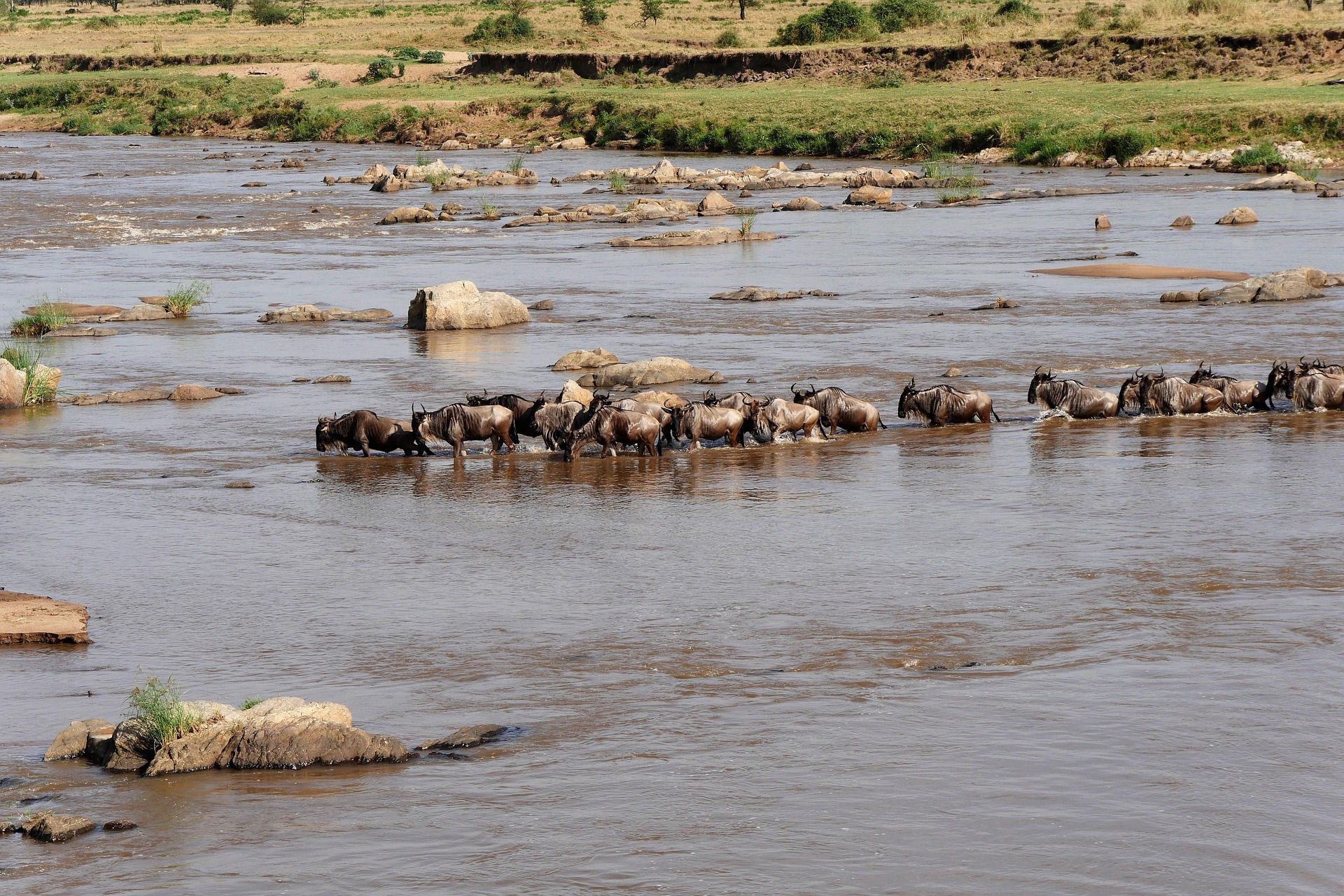
The Great Migration is not a single event that happens on one particular date. It is a year-round movement shaped by rainfall, pasture, water and the changing needs of more than a million wildebeest, together with zebra and other grazing animals.
Across the year, the herds may move between the Southern Serengeti, Ndutu, the Central and Western Serengeti, the Northern Serengeti and the Maasai Mara. The timing is influenced by natural conditions, so the route should be understood as a seasonal pattern rather than a fixed timetable.
For a 2027 safari, the most useful question is not only “Where will the migration be?” It is also which season, landscape and safari style best match your journey. This guide follows the movement month by month, helping you plan with realistic expectations without promising an exact wildlife location or guaranteed river crossing.
Planning the wider journey? Compare Tanzania’s safari seasons , read the Tanzania safari planning guide , or explore tailor-made safari packages .
Great Migration 2027 at a Glance
The migration follows a broad seasonal rhythm across Tanzania and Kenya, but the exact timing can change with rainfall, pasture and water. The pattern below is a planning guide, not a fixed wildlife timetable.
Southern Serengeti & Ndutu
The herds are commonly found around the Southern Serengeti and Ndutu during the calving season. Newborn animals attract intense predator activity, although the exact concentration can shift with conditions.
Central & Western Movement
As the grazing areas change, the herds may move through the Central and Western Serengeti. Rainfall can make this period especially green, dramatic and less predictable for road-based planning.
Northern Serengeti & Maasai Mara
The herds may move towards the Northern Serengeti and Maasai Mara. This is the period often associated with river-crossing searches, but crossings depend on water levels, herd behaviour and timing.
The Return South
With changing rainfall and fresh grass appearing in the south, the movement may gradually begin returning towards the Southern Serengeti. The cycle then starts again.
“The Great Migration is not a performance scheduled for one exact date. It is a living movement, and the best safari plan leaves room for nature to lead.”
The Great Migration Route Across Tanzania and Kenya
The migration follows a broad seasonal movement between the Southern Serengeti, Central Serengeti, Northern Serengeti and Kenya’s Maasai Mara. Rainfall, pasture and water levels influence the exact route each year.
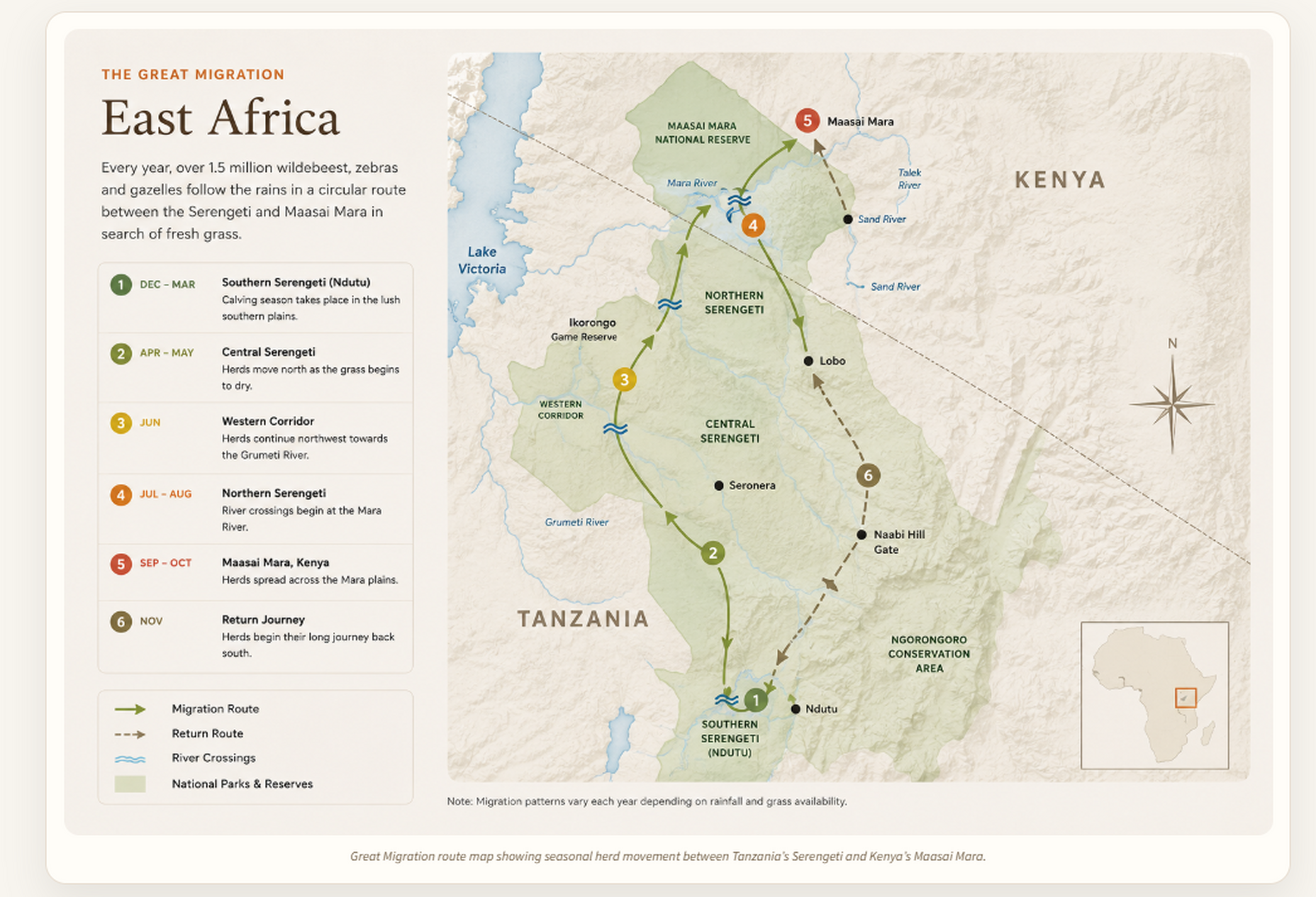
Often associated with the calving season at the beginning of the year, when the herds gather around fresh grazing areas.
As conditions change, the herds may move through the Central Serengeti in search of water and new pasture.
The northern region becomes important during the movement towards the Kenya border and the wider Mara ecosystem.
Some herds may continue into the Maasai Mara, where river crossings can occur when conditions and timing come together.
When and Where to See the Great Migration
The route on the map is a guide, not a fixed timetable. Rainfall and fresh grazing influence where the herds gather, how quickly they move and which areas offer the best viewing. The seasonal guide below explains the usual pattern.
January–March
Ndutu & Southern SerengetiThe southern short-grass plains usually hold large concentrations of wildebeest during this period. Calving is a major highlight, particularly around February, with newborn animals and active predators creating remarkable wildlife encounters. Exact timing varies with the rains.
April–May
Southern, Central & Western SerengetiAs conditions change, the herds generally begin spreading north and west from the southern plains. Movement can be dispersed rather than one continuous column. The long rains bring green landscapes, while road conditions and herd locations require flexible daily planning.
June–July
Western Corridor & Movement NorthHerds often gather in the Western Corridor around the Grumeti River before continuing towards the northern Serengeti. Some may reach the Mara River during July, although their arrival and any crossings depend on that year’s conditions.
August–October
Northern Serengeti & Maasai MaraHerds may move between the northern Serengeti and Kenya’s Maasai Mara, with Mara River crossings among the season’s best-known spectacles. Not all animals cross into Kenya, and crossings can happen in either direction. Waiting near the river never guarantees a crossing.
November–December
Return Towards the Southern PlainsWhen the short rains bring fresh grazing, the herds generally move south through parts of the eastern and central Serengeti. They may begin gathering around the southern plains and Ndutu during December, but arrival dates vary with rainfall.
Great Migration River Crossings: What to Expect
A river crossing can begin with a long, quiet wait. Wildebeest gather along the bank, approach the water, hesitate and sometimes turn away. The moment they enter the river is decided by the animals, not by a safari schedule.
Grumeti and Mara Rivers
The Grumeti River lies in the Serengeti’s Western Corridor, while the Mara River is associated with the northern Serengeti and Kenya’s Maasai Mara. Both feature in the migration story, but the experience varies with herd movements, river conditions and the crossing point.
A Gathering Is Not a Guarantee
Seeing a large herd beside the river does not mean a crossing will happen immediately. Animals may wait for hours, move elsewhere or remain on the same bank. Even during the usual crossing season, some game drives will end without a crossing.
Give the Wildlife Space
Keep viewing calm and follow your guide’s instructions. Never ask a driver to block the animals’ route, crowd the riverbank or pressure a herd into moving. The experience should remain a natural wildlife encounter.
Look Beyond the River
A migration safari is more than one dramatic moment. Herds spread across the plains, predators watch from nearby cover and the landscape changes throughout the day. Leave room to enjoy the wider wildlife experience, whether or not a crossing takes place.
The Great Migration Is a Journey, Not a Single Moment
The migration’s beauty lies in its changing rhythm: newborn wildebeest on the southern plains, long columns moving across the grasslands and herds gathering beside the rivers. No two visits unfold in exactly the same way.
Let the season guide your route, keep your expectations open and enjoy the wildlife beyond the headline moments. A memorable migration safari is about experiencing the whole landscape, not simply waiting for one crossing.
Great Migration Safari FAQs
Does the Great Migration happen all year?
The Great Migration is a year-round movement through the Serengeti–Mara ecosystem. Different seasons bring different experiences; river crossings are only one part of the journey.
Does the migration follow the same route every year?
The broad seasonal pattern is similar, but rainfall and fresh grazing influence the timing and location of the herds. A migration map is a planning guide, not an exact timetable.
Can a river crossing be guaranteed?
No. River crossings are unpredictable, and even a large herd beside the water may not cross while you are watching. No operator can guarantee a crossing on a particular day.
Do I need to visit both Tanzania and Kenya?
No. A migration safari can focus on Tanzania or Kenya, depending on your dates and where the herds are expected. Visiting both countries is an itinerary choice, not a requirement for seeing the migration.
Is the migration worth seeing without a river crossing?
Yes. Large herds, seasonal calving, predator encounters and wildlife spread across the plains are all part of the migration experience. A safari can be rewarding without witnessing a crossing.
Can I combine a migration safari with Zanzibar?
Yes. A migration safari can be followed by a Zanzibar stay. The route, connecting flights and accommodation should be arranged around your travel dates and confirmed availability.
Plan Your Great Migration Safari
Share your preferred dates, number of travellers and safari style with Rafiki Tembo Tours & Safaris. Our Tanzania team will help you shape a journey around the season, your interests and available accommodation.
Personal safari proposal · No booking obligation